
You’re working on a dirty, tedious home improvement project when you spot something out of the ordinary. It’s unnerving but piques your interest. After all, it could be hiding a big problem you’ll wish you hadn’t ignored in the first place. Oh so cautiously, you poke at it, scared of what you’ll find, though still knowing something gross could pop out any moment. A distinct odor wafts into the air, soon turning into a stench. Now, you’re certain it’s going to be unpleasant, but you’ve got to deal with it right now.
After a few more tense moments of poking, you can clearly see exactly what it is: a giant, out-of-control rat’s nest! Yuck! You have a family of grody rodents living right in your house, and you had no idea. Worried they’re taking over your home, you pick up your phone and run a search as fast as you can. What happens next takes you by surprise. You see “pack rat vs roof rat” right at the top and nervously realize you’re totally in over your head. This makes you even more curious; you want to know so you can deal with these intruders the right way.
Differences Between Roof Rats and Pack Rats
While both are rodents and share several characteristics, pack rats and roof rats do differ. You can tell them apart in a few ways, including their physical appearance and traits, nesting habits, and behaviors. Although some of these things are quite similar, others provide pretty stark contrasts. So, read on to learn the difference between roof rats and pack rats.
Physical Characteristics
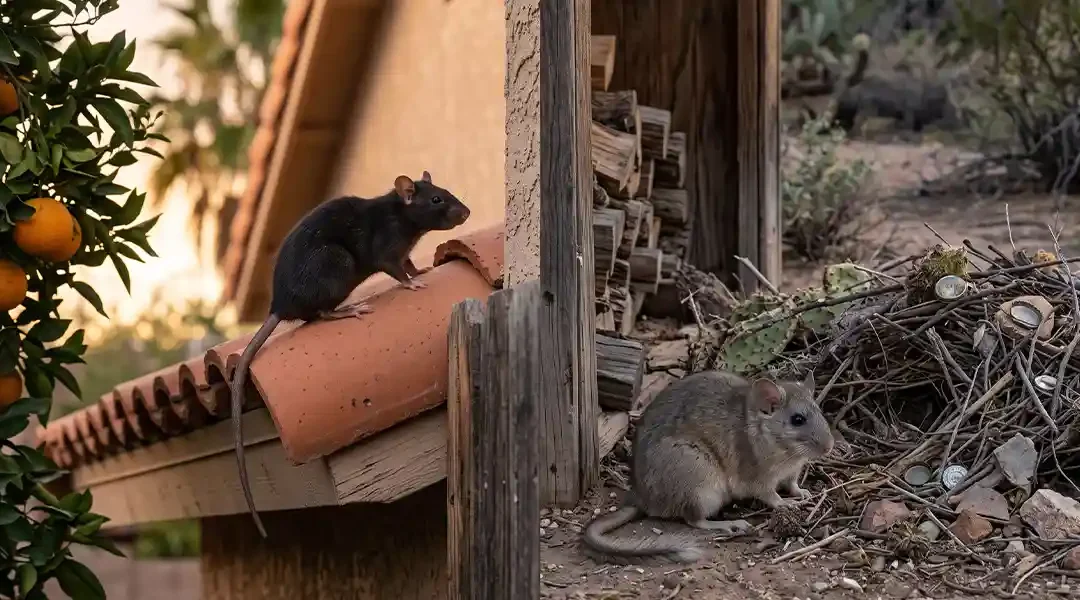
Roof rats and pack rats (or woodrats) differ in several ways. Roof rats are what most people think about when they think about rodents. Roof rats have slender body frames, usually dark or black fur, large ears, and those icky scale-like tails, which are longer than their heads and bodies combined. Meanwhile, pack rats have a short tail, rounded ears, and gray or brown fur. Pack rats also have big eyes and pronounced whiskers. Pack rats are also slightly larger, about 7 to 8 inches long, compared to roof rats, which are usually 6 to 8 inches long.
Nesting Habits and Location
Here’s one of the biggest telltale signs. Roof rats, as their name states, take up residence in high places, well off the ground. Roof rats are commonly found in attics, rafters, wall voids, trees, dense ivy, or palm fronds. They are excellent climbers and use things like rooflines, wires, branches, and more as bridges. Conversely, pack rats are most commonly found in low-level areas. Pack or wood rats prefer to construct large, prominent debris mounds—known as middens—using twigs, cactus pads, rocks, and vegetation. These nests are frequently located in woodpiles, under sheds, inside vehicle engine bays, or within crawl spaces.
Clues and Evidence Homeowners Can Look For
Other ways to tell the difference between roof rats and pack rats are their behaviors. Pack rats get their name from hoarding objects. They’ll collect all kinds of items, including coins, bottle caps, sticks, rocks, and other shiny and colorful prizes, and stuff them in their nests. Roof rats are heavily attracted to citrus and fruit trees, and these are primary targets.
Roof and pack rat droppings also share similar characteristics but differ slightly. Pack rats leave dark brown, cylindrical droppings that are about a half inch long, usually scattered around their nests. Roof rat droppings are also about a half inch long, but are spindle-shaped with pointed ends, and are left along elevated paths, ledges, attic beams, and other higher points.
Unfortunately, there’s no real way to tell the difference between wood rats and roof rats by the sounds they make. Both make scratching noises, scurry about, and make gnawing sounds, along with faint, high-pitched squeaks or chirps. So, they basically sound the same to the human ear.
Ways Property Owners Can Deal with Pack or Roof Rats
Of course, you should seal all cracks and openings that lead from the outside to the inside of your home, no matter if it’s near the ground or on the exterior by the attic. For roof rats, you’ll need to trim back or remove fruit trees, keep bird feeders secure, and store pet food in airtight containers. Since pack rats scurry across the ground, things like mulch and woodpiles are prime for the picking. Clear away surrounding debris, scrap metal, spare parts, and woodpiles. These items provide prime shelter and nesting materials for wood rats around houses and outbuildings.
Regardless of species, whether roof rats or pack rats, you can’t ignore either. Both reproduce rapidly and often. Both types of rodents will also wreak havoc on your property, no matter where they’re located, and spread to new areas if left untreated. What’s more, rats of any kind can carry diseases and, at the very least, cause widespread damage in several places, from sheds to attics, to crawlspaces, and plenty more. All of this, not to mention the fact that they pose a danger to children and pets because they will bite.