
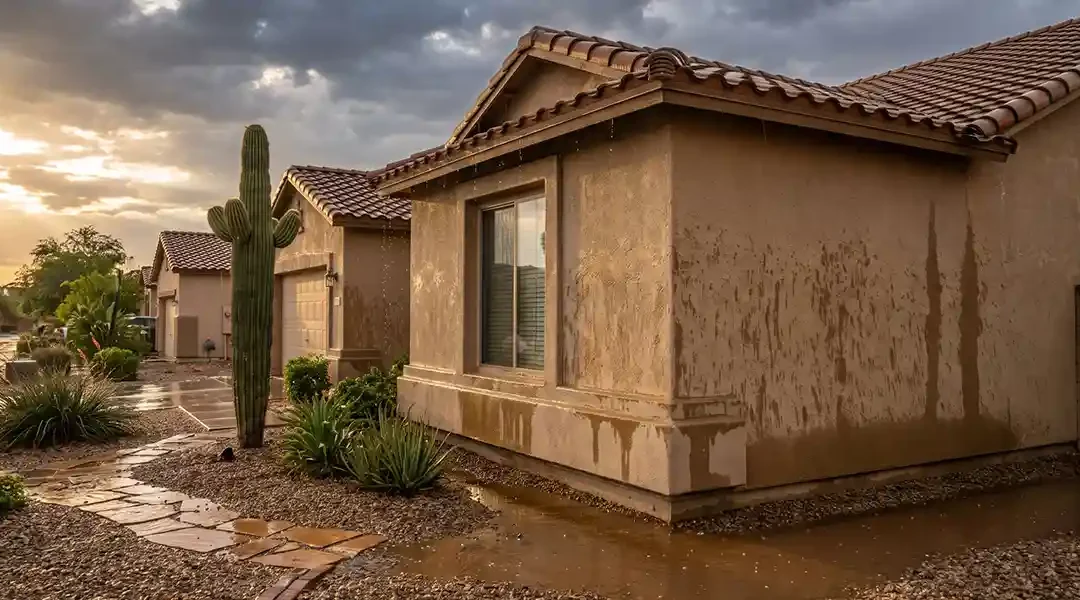
Monsoon season may soon be upon us. It might be a repeat of last year. Residents remember that, after nearly three inches of rainfall, the monsoon season didn’t start right away. Instead, there was a dry stretch in 2025, but ultimately, two-thirds of this precipitation fell in just a few days, creating dramatic flash flooding, massive wind damage, and airport chaos.
So, what does that mean for home and business owners? Well, it means insects will become a bigger problem than they already are. That’s right. Keep in mind that moisture is key to many insects; excessive moisture can be a condition conducive to pests, for example, termites and weeds. Not to mention that flooding can drive ants into structures. What’s more, in the time it takes to dry out, that moisture can create great opportunities for bugs, ideal conditions, and food sources.
So, that means you need to be prepared not only for a possible deluge but also for what that water brings, including pests like bugs and rodents. Which, in turn, means partnering with a trusted name in pest control that has the track record to prove it and deliver results.
Monsoon Season Basics
Here’s the thing about monsoon season: the calendar doesn’t start it. Moisture does.
For decades, the National Weather Service marked the beginning of monsoon season in Phoenix the moment we hit three consecutive days with an average dew point of 55°F or higher. That number wasn’t arbitrary. As Arizona State University’s School of Geographical Sciences and Urban Planning explains, a 55-degree dew point in Phoenix corresponds to about one inch of precipitable water in the atmosphere — the moisture load needed to fuel real thunderstorms. Tucson used 54 degrees. Depending on the year, that trigger could arrive anywhere from mid-June to late July.
The NWS eventually swapped that standard for a fixed calendar window, June 15 through September 30, mostly to simplify public safety messaging. But the dew point still tells you what’s actually happening outside, and it’s the number that matters for your property. When the air holds that much water, the ground holds it too. Soil stays damp. Wood stays damp. Shaded areas along your foundation may not dry out for weeks.
That’s the number pests respond to. Termites don’t check a calendar before they swarm, they respond to soil moisture and humidity. Ants get flooded out on the day the storm hits, not on June 15th. So when you see three straight days of 55-degree dew points on the forecast, treat that as your signal to get ahead of the problem, regardless of what the official season dates say.
Peak activity still lands squarely in July, August and September, with dramatic thunderstorms, heavy humidity, and the bulk of the season’s rainfall.
How Excessive Moisture Drives Pest Issues
Obviously, with lots of rain comes lots of residual moisture. And moisture from monsoon rains is a major trigger in arid regions. It creates ideal conditions for many pests, which include, but are not limited to:
- Termites. Termites thrive in humid, moist environments. Rain softens soil, raises humidity, and can activate subterranean termites. Swarming often follows rain events, increasing the risk of new colonies. Damp wood becomes far more vulnerable.
- Ants. Flooding displaces ant colonies, driving them indoors for shelter and food. Species like odorous house ants surge; they seek moisture and crumbs.
- Weeds. Winter annuals germinate with late-summer/early-fall moisture. Rains promote the rapid growth of weeds that serve as food/habitat for pests.
- General insects and opportunists. Standing water and high humidity can boost populations of mosquitoes, cockroaches, crickets, and more. Flooded nests push bugs inside; decaying organic matter provides food sources. Scorpions and spiders also become more active.
Then, there’s the drying time factor. The lag between rain and full dry-out (especially in soil and in wood) extends the window for pest activity—often weeks in shaded or poorly drained areas.
Tips for Prevention and Management in August
Now, what is it that you can do to protect your property? It’s a smart question to ask because there’s a lot at stake. Fortunately, there are a few steps you can take to help prevent pests from parading on your property and penetrating your home:
- Moisture control. Fix leaks, improve drainage, clear gutters, and slope soil away from foundations. Use dehumidifiers indoors.
- Yard maintenance. Remove standing water, trim vegetation, and eliminate debris/weeds to reduce hiding spots and food sources.
- Sealing. Caulk cracks, install door sweeps, and screen vents—critical when rains drive pests inside.
- Monitoring. Watch for swarms (termites/ants), mud tubes, or sudden indoor trails after storms. Early professional inspection pays off.
Lastly, there’s the timing. Proactive treatments before peak rains or right after can limit explosions.
Additional August Pest Watchlist
Although there’s a lot you can do to fend off termites, ants, and weeds, the list doesn’t stop there. That’s because there are other invaders. For instance, mosquitoes and flies flock during the monsoon season, as breeding in standing water explodes. Then, there are those disgusting cockroaches, which absolutely love the humidity and organic debris. If that’s not enough, be on guard against stinging Insects (such as wasps and bees), because they’ll be more active in foraging. Furthermore, rodents and scorpions, displaced by floods, will seek dry shelter.